
Klimt revisited
When a ‘Kiss’ isn't just a kiss

As I prepared for a recent trip to Vienna, my host, a dear relative, asked me what I’d like to do. The city is full of music. That, and the Freud museum, the Naschmarkt, the nearby forests, I suggested. But it was Gustav Klimt’s iconic ‘Kiss’ – his most famous painting – housed at the Belvedere Museum, that was top of my list. As a teenager, I’d tacked a postcard of it up in my bedroom, along with Herb Ritts’ black and white photographs. During those years, the gold of Klimt’s painting shone iridescent from my closet door. There was something decoratively brilliant about it, risky almost. I knew nothing of the artist, but its dream-coat passion drew me in.
The Belvedere Museum is crowded when we arrive; the weekend before Easter fills Vienna with tourists both local and from abroad. Entering the former palace through the main doors, we quickly cross the lobby to the first room where the Egon Schiele paintings, half-knowing, half-grotesque, enthral the eye. The pink of the walls reminds me of the interior of the Thyssen, a collection I used to visit when I lived in Madrid. I feel the same excitement. But here in Vienna; we’re in the artist’s city home.
Walking through rooms of Monets and paintings by Austrian artists: Oskar Kokoschka and Richard Gerstl, I know we’re getting closer to ‘The Kiss’ when the disparate visitors become a crowd. We’ve already passed a room of lesser-known Klimt paintings, the first of which, ‘Portrait of a Woman’ (1893/4) halts our passage. We’re stopped, astonished, by the delicacy of her skin, an interiority in her expression, the frankness of the light.
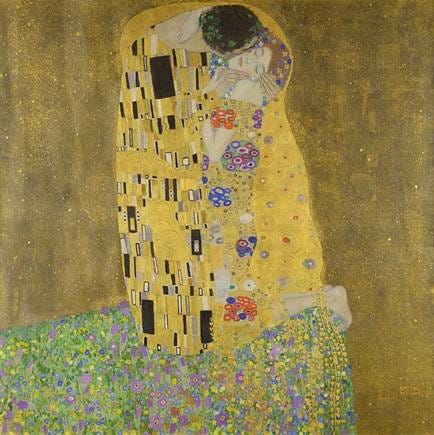
We’re now at the entrance to the room of the well-known painting. Not a massive work, ‘The Kiss,’ (1908) shines sedately from a far wall. A group of people standing beside it are being spoken to by a guide. Some hold up phones to capture the image, and as more visitors enter, they move like magnets towards the spot where it hangs. Similar to the hordes of onlookers who flock to the Mona Lisa at the Louvre, drawn mainly by its fame, we move closer too, and as we do, I stop – not from awe this time, but surprise.
The image I’d grown up seeing in my room, a man clutching the face of a woman and embracing it while her toes curl against a ground of coloured flowers and trinkets, doesn’t evoke the romance I knew. The man in the painting appears to loom over the woman whose face is pale, and flat, turned to one side. Expression absent, her eyes are closed. She could be a cut-out or a mask. A thin hand grasps weakly at his. Is she trying, but failing, to pull him off?
Is she even alive?
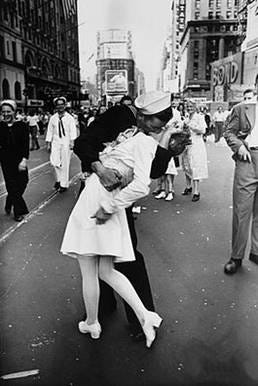
There’s a well-known black and white photograph taken in Times Square on V-J day, August 1945. You may know it. A US sailor has grabbed the nearest woman from the street, and among the celebrations, he leans over, and kisses her, as she leans backward, surprised by his hold. Like Klimt’s ‘Kiss’, the man’s face is hunched over the woman’s and here, again, the woman is static, pulled beneath his posture like a prop.
As the World War Two photographer, Alfred Eisesenstaedt, captured the moment, was he recalling the Austrian painter’s ‘Kiss’?
The woman shown in the 1940s photograph, Greta Zimmer, has since stated publicly that she didn’t consent to being embraced. Modern viewers have revisited this photograph, originally an emblem of the high of allied victory post-World War Two, and called it subjugation.
Was Eisesenstaedt’s photo celebrating victory, or the plundering of war?
Wondering, we stand in front of Klimt’s most looked-at work. Rather than the romantic expression evoked by its title that charmed a fourteen-year-old me, ‘The Kiss’ is starting to resemble an ode to might.
Amongst the gold leaf, the swirling pattern and floral bed beneath, the woman’s shuttered visage might be a death mask. The liveliness of Klimt’s burnished palette of golds and greens, a foil to a man embracing an end.
Like Lorca’s ‘duende,’ the dark mysterious force particularly present in music and poetry – an otherworldly sound that transcends technique and skill - perhaps the woman’s pallor isn’t about the 19th century ideal of beauty, or even reciprocal romantic love, but a symbol. The erotic as antidote to annihilation. A man grabbing death to confirm he is alive.
Perhaps this is what people are responding to. Why this painting may forever draw a crowd. ‘The Kiss’ was originally named, ‘The Embrace’ – but the woman in the frame seems far from an active participant. Rather than the celebration of intimacy I had understood at first sight, Klimt’s ‘Kiss’ might not be about love or affection or attraction at all, but the seduction of power.
As we know, the notion of woman as prop – or property – hails far further back than a 19th century canvass. My relative tells me that in France, where he lives half the year, an acquaintance who works for the Green Party recently campaigned to have an ancient dictum repealed that still commits French women, by law, to conjugal relations with her husband. Talk about harshing the vibe. Rightly, the French parliament agreed, and it has since been removed from the statute.
After some time at Klimt’s ‘Kiss’, we wander back to the artist’s earlier work, the very first painting displayed at the gallery entrance: ‘Portrait of a Woman’.
In her black taffeta gown with its exaggerated ruched sleeves, the artist’s model looks away from the onlooker, mouth pensive, eyes distant. Her left hand is gloved, the right is bare. Hair tied back in a messy style, she looks like a person who might have got dressed in a rush for an evening out. She certainly isn’t a passive mask.
Shining from her eyes, we sense an internal glow – the lights are on – somebody home. A tribute, perhaps, by the artist, to a shared humanity.
******************************************************************************************
*Image: Gustav Klimt, ‘The Kiss’ 1908 (public domain)
**Image: Alfred Eisenstaedt, ‘Legendary kiss V–J day in Times Square’ 1945 (Originally published in Life Magazine, 1945. Derived from a digital capture. (Source = en.wikipedia.org.) Copyright held by the publisher or the artist. Claimed as fair use regardless. The image itself is the subject of the above commentary rather than the event it depicts. It is believed that this will not cause commercial harm to the copyright holder. )
When I was in Vienna last time, my partner was eager to show me the "kiss". I wasn't familiar with the artist then, even though I saw reprints of his paintings before in magazines and documentaries. When I first saw the real painting and its descriptions, I told my partner the woman in the painting appeared to be dead to me and her golden dress reminds me of the ancient Chinese burial traditions. Even now, in villages and small towns, people prepare jackets embroiled with golden-colored threads for their parents to wear during cremation after their passing once the parents reach certain age. In this painting, the man didn't look that much more alive than the woman to me. So, to me, it's more about relationship between a couple after death. The painter might be trying to convey his idea about "Till death do us part “. Several of the highest auction prices of oil paintings last year are Klimt's for some reason.